
BlogMonovi
AI changes data gathering and analysis
Discover how AI is reshaping the data analysis process, shifting engineering focus from manual data prep to prompt logic, validation, and domain context.
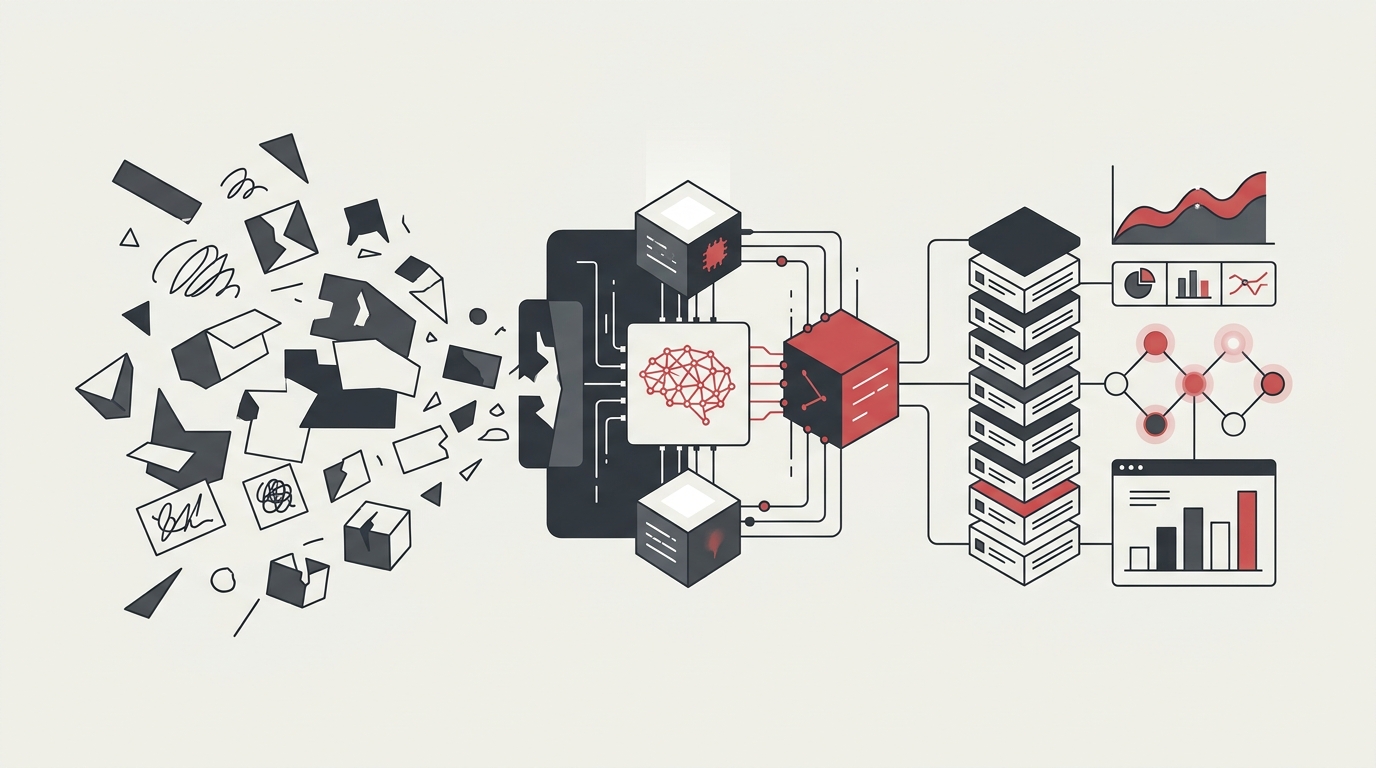
For years, the core bottleneck of data analysis has not been a shortage of questions, but the mechanical friction required to answer them. Analysts traditionally spend the bulk of their time parsing unstructured files, resolving schema mismatches, writing boilerplate SQL, and formatting outputs for business teams. Artificial intelligence, particularly modern language models and automated machine learning, changes this baseline. It does not replace the necessity of analytical rigor, but it fundamentally rearranges where human effort is spent.
To understand this shift, teams must look past the hype of fully autonomous decision-making and inspect how analytical workflows are practically operating today across engineering and operations teams.
1. Automated Data Ingestion and Preparation
Data preparation has historically consumed at least 20 percent of an analyst's working hours. Traditional Extract, Transform, Load (ETL) pipelines require strict, brittle mappings. If a partner changes a column header in a shipping manifest or an invoice format shifts from a two-column layout to nested tables, pipelines break. Engineers have to step in, debug the parser, and deploy a patch.
AI transforms this phase from brittle deterministic rules to probabilistic normalization. Machine learning models and LLM-driven parsers can infer entity relationships, detect anomalies in incoming data, and standardize erratic values without explicit rules for every edge case.
- Schema Reconciliation: AI tools map incoming fields to unified warehouse tables, understanding that weight_kg, gross_mass, and wgt represent the same metric.
- Error and Anomaly Detection: Instead of relying only on hard thresholds, models identify multivariate outliers—such as a route taking an abnormal duration relative to fuel consumption and historical traffic patterns.
- Unstructured to Structured Extraction: Documents like customs declarations, bills of lading, and free-text dispatch notes are reliably converted into queryable structured rows.
This shift moves data teams from manual cleaning operators to quality gatekeepers who set verification boundaries.
2. From Handcrafted Queries to Conversational Interfaces
Writing queries has always created an operational divide inside organizations. Domain experts—warehouse supervisors, foreign trade managers, and logistics dispatchers—know what operational answers they need, but they rarely write SQL or Python. They submit requests to centralized business intelligence (BI) teams, leading to backlogs.
Text-to-SQL and natural language analytics engines lower this interface barrier. By feeding semantic layers, database schemas, and data dictionaries into LLMs, domain users can query databases directly using natural language.
However, this introduces new technical responsibilities:
- Semantic Layer Maintenance: AI cannot query ambiguous tables accurately. Data teams must define clean, unambiguous metrics (such as defining precisely what constitutes an "active shipment" or "cleared customs") so the model generates accurate queries.
- Execution Safeguards: Uncontrolled natural language interfaces can easily generate queries that scan terabytes of data unnecessarily or execute destructive operations. Engineers must enforce read-only environments, query timeouts, and strict partition pruning.
- Explainability: Analysts must verify generated SQL. A query can return a clean number while using an incorrect table join that silently distorts business metrics.
At Monovi, where software interfaces directly with complex physical operations like track-and-trace monitoring and cross-border transport, we observe that conversational tools only succeed when the underlying operational data model is rigorously structured first.
3. Exploratory Analysis and Pattern Recognition at Scale
Traditional exploratory data analysis (EDA) relies on human intuition. An analyst forms a hypothesis—for example, that delivery delays spike on specific cross-docking routes on rainy days—and builds visualizations to confirm or disprove it. The risk is confirmation bias; analysts only find the anomalies they know to look for.
AI shifts exploratory analysis toward automated correlation discovery. Machine learning models can scan high-dimensional datasets simultaneously, identifying latent correlations, trend breaks, and cluster shifts without waiting for a manual hypothesis.
- Automated Root-Cause Analysis: When a performance indicator drops, algorithms can decompose the metric across hundreds of dimensions to surface which specific distribution center, carrier, or SKU caused the divergence.
- Synthetic Scenario Modeling: Rather than projecting linear historical trends, predictive systems simulate supply chain disruptions or regulatory bottlenecks under varying real-world conditions.
- Automated Summarization: AI engines can synthesize complex multidimensional dashboards into concise textual briefs, highlighting significant variances for operational teams.
This broad pattern identification does not eliminate the analyst. A statistical correlation does not equal operational causality. The analyst's job becomes one of contextual evaluation: determining whether a discovered pattern reflects a genuine operational bottleneck or a data collection artifact.
4. The Changing Role of the Human Analyst
With AI handling ingestion, drafting queries, and scanning for initial patterns, the day-to-day requirements of analytical work change. Technical syntax becomes less of a moat; domain competence, systems thinking, and data governance become paramount.
The modern analyst must cultivate three core proficiencies:
- Auditing and Verification: Knowing how to design validation suites that catch hallucinations, data drift, and faulty join logic before numbers reach leadership.
- Translating Operational Reality into Code: Knowing how physical processes work. In logistics, for instance, a software timestamp rarely tells the whole story without understanding actual dock congestion or driver handover routines.
- Data Privacy and Governance: Ensuring sensitive trade data, regulatory documents, and customer identifiers are not exposed to public model endpoints or processed in violation of compliance rules.
AI changes data analysis by removing the mechanical drag that kept teams buried in spreadsheets and ad-hoc scripts. By treating AI as a tool for translation and exploration, engineering and data teams can spend less time moving bytes around and more time making operational decisions that deliver tangible business outcomes.
Related
- What Does Monovi Offer for Tobacco Track&Trace Compliance?Discover Monovi TTOps solutions to eliminate regulatory risks from your commercial operations in the EU market and ensure uninterrupted data flow across your manufacturing and import processes. Entrust your technical and operational processes to our expert team and stay focused on your core business.
- Tobacco Track and Trace in KSA and UAEA practical guide to tobacco track and trace compliance in KSA and the UAE, covering tax stamp rules, serialization, and Monovi TTOps support.
- Tobacco Tracking and Tracing in United KingdomUnderstand UK tobacco track and trace compliance, technical data flows, and how TTOps manages 24/7 operational support for manufacturers.
Next step
Let us make the next step clear.