
BlogMonovi
How AI Is Changing the Data Analysis Process
Discover how AI changes data analysis across cleaning, exploration, and reporting by shifting human effort from manual execution to verification.
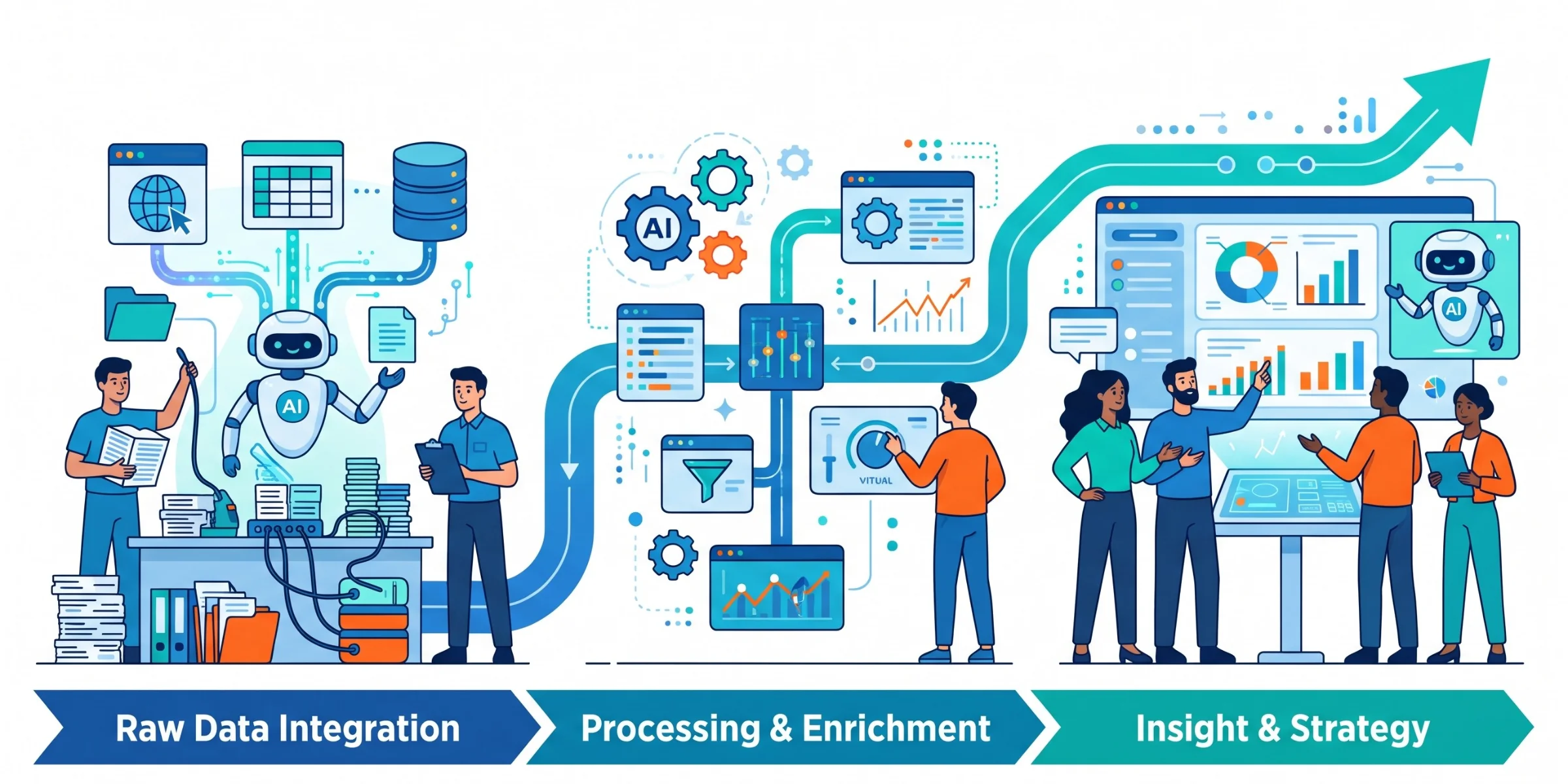
When people talk about AI in data analysis, they usually jump to the end: smartdashboards and assistants that answer questions. But the real change starts much earlier.AI is reshaping data analysis quietly, one stage at a time, and at each stage people movefrom doing the work by hand to guiding and checking it.
Defining the business question
AI can summarize stakeholder meetings and turn rough notes into draft KPI definitions.But when a manager asks for "a sales report" and really wants to know why one region isfalling behind, only a person will notice.
Collecting and integrating data
AI helps write pipeline code, map fields between systems and pull data out of PDFs,invoices and emails that used to be ignored. Deciding which sources to trust, and how tohandle access and privacy, is still up to people.
Cleaning and preparing data
Cleaning has always been the slowest part of the job. AI now profiles data in seconds andsuggests fixes. Yet a sudden sales spike could be an error or a successful campaign, andonly someone who knows the business can tell.
Modeling data
AI can suggest relationships, draft DAX or SQL measures and write descriptions. This iswhere human care matters most: every AI tool downstream depends on the model, andclear names and agreed definitions are what keep its answers right.
Analyzing data
AI can write and run analysis code, build quick forecasts and suggest what is behind achange. Analysts can test many more ideas. But AI finds patterns, not meaning, so askinggood questions and challenging the answers stays human work.
At Monovi, where software integrates directly into ground transport, tobacco track-and-trace, and international trade operations, we see daily that software must reflect operational physical realities rather than purely statistical patterns. An AI model can suggest predictive features, but human domain experts must validate whether those features reflect durable operational truths or coincidental data quirks.
Visualizing and reporting
With tools like Copilot in Power BI, a first report draft can come from a short description,ready for stakeholders the same afternoon. Deciding what to highlight and what to leaveout is still a design choice people make.
Sharing insights and supporting decisions
Reports now come with automatic summaries and alerts, and users can ask follow-upquestions in plain language. This adds a new way in rather than replacing dashboards.Turning a number into action still takes a person the business trusts.
Monitoring and maintenance
AI can watch pipelines and KPIs around the clock, catch problems early and keepdocumentation current. People set the rules: what to watch, what counts as a problemand what the system may do on its own.
What this means for data professionals
Across every stage, AI takes on the repetitive work: routine code, manual cleaning,standard reports. People spend more time on data quality, solid models, checking AI'soutput and understanding the business. Roles are blurring too, so those who understandthe whole process gain an edge.
The fundamentals still matter. You can only judge an AI-generated query or forecast if youknow how it should be done.
The New Baseline for Technical Teams
The real impact of AI on data analysis is not the elimination of human labor; it is the elevation of the quality bar for domain understanding. Writing syntax, wrangling messy strings, and generating basic summary charts are no longer the bottleneck. The real bottleneck is knowing whether the data represents the ground truth of the operation.
As tools automate routine mechanical tasks, the analyst's value centers on system design, validation criteria, and operational context. The teams that thrive will not be those that trust automated dashboards implicitly, but those that master the discipline of guiding, auditing, and checking machine outputs against physical realities.
Final thoughts
AI isn't removing any stage of data analysis; it's making each one faster. The organizationsthat benefit most won't just add a chatbot on top of their reports. They'll strengthenevery stage underneath, with clean data, trusted models and skilled people.
Related
- What Does Monovi Offer for Tobacco Track&Trace Compliance?Discover Monovi TTOps solutions to eliminate regulatory risks from your commercial operations in the EU market and ensure uninterrupted data flow across your manufacturing and import processes. Entrust your technical and operational processes to our expert team and stay focused on your core business.
- Tobacco Track and Trace in KSA and UAEA practical guide to tobacco track and trace compliance in KSA and the UAE, covering tax stamp rules, serialization, and Monovi TTOps support.
- Tobacco Tracking and Tracing in United KingdomUnderstand UK tobacco track and trace compliance, technical data flows, and how TTOps manages 24/7 operational support for manufacturers.
Next step
Let us make the next step clear.